
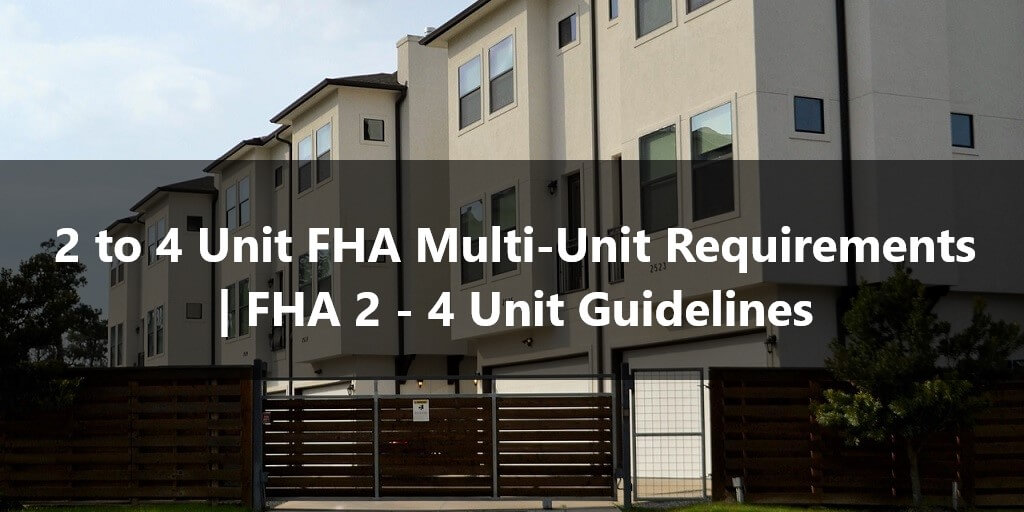
2 to 4 Unit FHA Multi-Unit Requirements
Financing for a multi-unit (2 to 4 unit) is possible with a FHA multi-unit mortgage. The down payment is 3.5% with a 580 FICO or higher. Owner occupied multi family financing is desirable to borrowers who plan to occupy one of the units and rent out the remaining units.
2 to 4 unit properties allow borrowers to be a homeowner and landlord, which can generate residual income to pay down the mortgage to build equity faster or generate passive income. It is important to understand FHA multi-unit guidelines and work with a mortgage company that does not have an internal guideline on top of a FHA guideline called an overlay.
Types of Properties are Allowed
When a borrower qualifies for an FHA mortgage for a multi-unit property, they have to occupy one of the 2 to 4 units. The multi-unit can either be:
- Two units (duplex) – two unit property that is considered a single family residential property.
- Three units (triplex) – three unit property that is considered a single family residential property.
- Four units (fourplex) – four unit property that is considered a single family residential property.
Mixed Use
Properties that have a combination of residential, commercial, retail, office or parking space can be acceptable. Mixed use for 2 to 4 unit properties are eligible for FHA insurance if:
- 51 percent of the entire square footage is for residential use.
- Commercial use cannot affect the health and safety of the occupants.
Accessory Dwelling Unit
An accessory dwelling unit is a single living unit that can be internal, attached or detached. A single family residence could still be considered a one unit property and rental income can be used. If the property is two or more units, the accessory dwelling unit is considered an additional unit.
These types of properties must meet and comply with local zoning and conform to the area. Reserve requirements must be met if rental income is being used.
Reserve Requirements for FHA Multi-Unit Properties
All cases can vary based on the Automated Underwriting System (AUS), but can be run by a Loan Originator during the pre-approval process.
- For 3 to 4 unit properties, the mortgagee must verify and document that three months of principal, interest, taxes and insurance (PITI) are available.
- For a 3 to 4 unit property and manual underwriting, three months of PITI must be verified and documented.
- For 2 unit properties and manual underwriting, one month of PITI must be verified and documented.
3 to 4 Units Self-Sufficiency Rental Income
A self-sufficiency test must be met in order for the 3 to 4 unit property to qualify for an FHA loan. Rental income from the 3 to 4 unit is calculated by using the appraiser’s fair market rent from all units, including the unit the borrower chooses to occupy, and subtracting the greater of 25 percent of the fair market rent or appraiser’s estimate for vacancies and maintenance.
Principal, interest, taxes, and insurance (PITI) divided by the monthly net-self sufficiency income cannot exceed 100 percent for 3 to 4 unit properties.
Using Rental Income for 2 to 4 Unit Properties
Proposed rental income may be used when verified by the mortgagee by obtaining proposed rental income showing fair market rent on an appraisal.
For limited or no history of rental income:
- Fannie Mae form 1025 or
- Freddie Mac form 72 – Small Residential Income Property Appraisal Report.
- If available, prospective leases.